






resource hub
MOUNTADAPT’s goal is to develop a comprehensive series of adaptation solutions and resources. They are aimed to help health systems in mountain areas strengthen their resilience against the impacts of climate change. These solutions include tools, guidance, training, reports, and awareness-raising materials.
Updates on the solutions are progressively published on this page as they become available.

Developing and testing
D6.4 – Revised Data Management Plan
The primary purpose of this Data Management Plan (DMP) is to provide MOUNTADAPT consortium members with guidelines for handling, processing, and sharing project data responsibly. This document is aligned with FAIR (Findable, Accessible, Interoperable, and Reusable) principles and complies with GDPR requirements for data protection. The DMP will be regularly updated throughout the project to address evolving data needs and to ensure data sustainability and compliance. The first DMP document (D6.2) was delivered in M6.
This Data Management Plan has been prepared in line with the Horizon Europe guidelines, following the Horizon Europe DMP template. It was initially based on the responses collected from the project partners at the start of the MOUNTADAPT project and, in this revised version, has been updated to reflect the practical experiences gained from data analysis during the implementation of project tasks in the first half of the project.

Upscaling and replicating
D3.1 – Monitoring protocols and methodology for solutions’ effectiveness assessment
This deliverable reports on the monitoring protocols and methodology for all solutions’ effectiveness assessment, including the trainings, alongside the methodology that needs to be followed for being effective in demonstration sites, and the collection of information to tailor the existing TransformAr Avoided Damages framework and application (TADA). The deliverable is divided in three sections:
- A. Monitoring protocols and methodology
- B. Preparation of the methodology for the evaluation of training
- C. Tailoring of the Impact Assessment framework and application
Upscaling and replicating
D2.2 – Monitoring, Early Warning and Response System Development and Adaptation Report
The MEWRS framework aims to deliver an all-encompassing, end-to-end multi-hazard Monitoring, Early Warning, and Response System to build resilience against health risks caused by climate change. The project architecture integrates independent tools that interoperate seamlessly, ensuring continuous environmental surveillance, risk modeling, warning communication, and efficient crisis management. This report presents the process and outcomes related to the development and adaptation of the key components within MEWRS.

Developing and testing
D2.3 – Guidance and recommendations co-creation
This deliverable provides practical, evidence-based guidance to help close the gap between high-level policy commitments and local implementation of climate-health action. It addresses four key domains where climate mitigation, adaptation, and health co-benefits intersect: building performance through nature-based and hybrid solutions, health system preparedness for climate-related disasters, integration of climate resilience into healthcare governance, and safe physical activity during climate alerts in mountain regions.

Assessing
Disaster Preparedness Checklist and Guidance
Developed by MOUNTADAPT project partner CRIMEDIM (the Centre for Research and Training in Disaster Medicine, Humanitarian Aid and Global Health at the University of Eastern Piedmont), this tool is a structured checklist designed to support health system representatives in assessing disaster preparedness at the local level. It combines a standardized assessment format with evidence-based guidance, enabling representatives to evaluate their system’s preparedness against specific criteria.
Capacity building
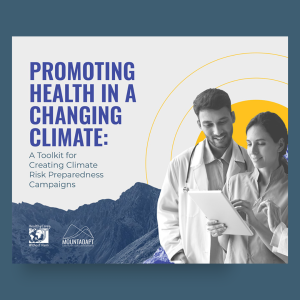
MOUNTADAPT Awareness-Raising Campaign Toolkit | Promoting Health in a Changing Climate
This resource is a comprehensive guide that supports groups or individuals – such as healthcare professionals, public health authorities, and local organisations – to develop awareness-raising campaigns for audiences in their community on the health risks and impacts caused by climate change. It provides step-by-step guidance, practical examples, and strategies for campaigns at low, moderate, and high budgets – making it adaptable across contexts and resources. The toolkit is part of MOUNTADAPT D2.4, and will be tested in MOUNTADAPT demonstration sites in 2026.

Resources
In-depth investigation on the connection between climate change and NCDs
This report presents a comprehensive picture of how climate change influences human
well-being and the urgent need for mitigation and adaptation strategies. It comprises
of five chapters that collectively examine the relationship between extreme weather
events (EWEs), health risks, and the broader implications for health systems, public
health strategies, and disease patterns.
Developing and testing
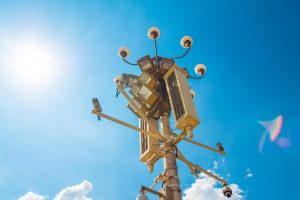
Sentinel
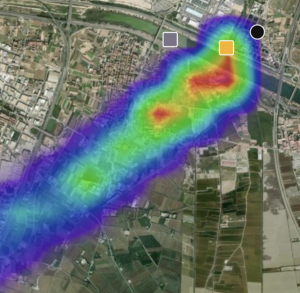
AirAdvanced® Sentinel is SUEZ‘s innovative solution for monitoring air quality. Sentinel allows users to
– visualise weather, air quality, and pollen in real time with strategically placed stations
– connect different types of stations according to specific needs
– investigate past incidents to understand and resolve issues
– anticipate future situations with advanced modelling
Developing and testing
Nature-based and hybrid solutions sensitivity simulation
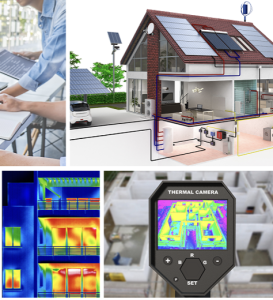
CSTB will use a numerical simulation tool to anticipate a building’s performance against future extreme weather events and select reliable technical solutions for building adaptation. Nature-based and hybrid solutions adapted to the mountain environment will be defined and simulated for building construction/renovation and operation design. The probability of occurrence and a reliability assessment will provide the level of adaptation to climate change for each technical solution. Involved stakeholders will have the information needed to make decisions on construction/renovation actions.

Developing and testing
VECTRACK
VECTRACK – co-developed by IRIDEON is an Internet of Things end-to-end solution for the digital early warning of vectors (carriers) of arboviral diseases (viruses transmitted by mosquitoes). VECTRACK sensors deployed on the ground automatically collect and analyse information about these vector, which is then wirelessly transmitted to a machine-learning cloud server. The information is made available in near real-time (updated every 30 minutes), and each recorded event is tagged with a time stamp with a resolution of 1 second. VECTRACK will be implemented and demonstrated at different sites, to extend and validate the usability of the solution in vector surveillance in mountain conditions.
Developing and testing
Indoor environmental quality (IEQ) monitoring method
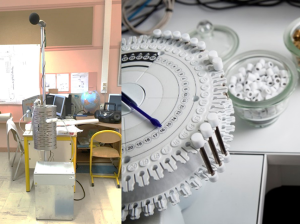
CTSB will co-develop a holistic indoor environmental resilience (IER) metric for evaluating the thermal environment and the indoor air quality for healthcare facilities in each demonstration site. CSTB will adapt the indoor monitoring tool of the French Observatory for Indoor Environmental Quality (OQEI) to healthcare facilities based on the specificities of each demonstration site and develop an on-site method to monitor the IER metric according to standardised methods and/or using cost-effective sensors.